
Learning opposites is key to better talking. Knowing words and their opposites helps you talk clearly. It’s a foundational pillar for good English learning.
Studying English Antonyms With Practical Examples helps you more than just memorize. It shows how words connect us. This guide will help you learn more words and talk with confidence.
In this article, you’ll learn to sort opposites well. We’ll look at common word pairs for work and fun. By the end, you’ll know how to pick the right word every time.
Key Takeaways:
- Understand the role of opposites in building a robust vocabulary.
- Learn how to apply word pairs in real-world scenarios.
- Follow a clear, step-by-step method to improve your fluency.
Understanding the Role of Antonyms in Language Proficiency
Learning about word opposites can make you better at talking and writing. Vocabulary building is more than just remembering words. It’s about seeing how words are connected.
Why Opposites Matter for Fluency
To be really good at a language, you need to know more than just what words mean. You have to see the whole range of ideas between words. Knowing the opposite of a word helps you understand everything about that idea.
This way of thinking makes it easier to find the right words fast. For example, knowing «bright» and «dim» helps you talk more smoothly. It saves time and makes your speech sound better.
How Antonyms Expand Your Descriptive Range
Using more words can make your descriptions better. Instead of simple words, you can pick ones that are more precise. This shows you’re really good at using language.
The table below shows how using better antonyms can make your writing and talking better:
| Basic Pair | Advanced Pair | Contextual Impact |
|---|---|---|
| Good / Bad | Beneficial / Detrimental | Professional tone |
| Big / Small | Immense / Minute | Descriptive accuracy |
| Happy / Sad | Elated / Dejected | Emotional depth |
| Fast / Slow | Rapid / Sluggish | Action clarity |
Categorizing Antonyms for Easier Memorization
When you sort your vocabulary, you make it easier to remember. By grouping antonym categories, you learn more than just words. You understand how language works.
This way, you can organize new opposite words as you see them. This helps a lot in your daily reading and listening.
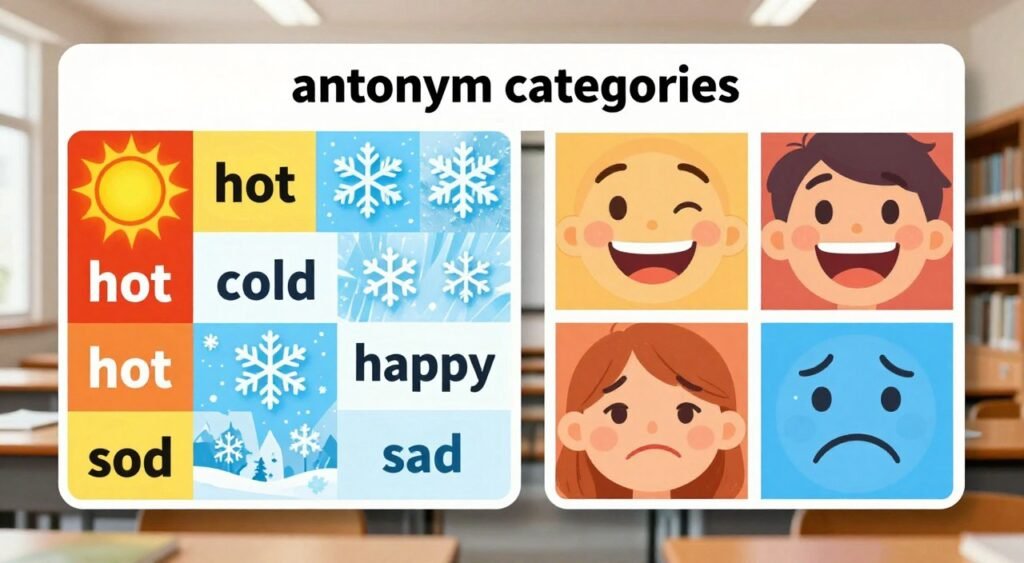
Gradable Antonyms and Their Scales
Gradable antonyms are on a scale. They show qualities that can change, like hot and cold or big and small. You can adjust these words with «very» or «slightly.»
These words have a middle point. For example, something not hot might be warm, cool, or cold. Knowing this sliding scale helps pick the right word.
Complementary Antonyms and Binary Choices
Complementary antonyms are like a yes or no choice. These opposite words are complete opposites. If something is «dead,» it can’t be «alive.»
These pairs don’t have a middle. You’re either «on» or «off,» «present» or «absent.» Learning these antonym categories helps you use clear language.
Relational Antonyms and Perspective Shifts
Relational antonyms show a relationship from different views. These pairs need each other to make sense. A good example is «teacher» and «student.»
Using these terms changes the perspective of what you say. This helps describe complex things more accurately. The table below shows how these opposite words work in English.
| Category | Primary Feature | Example Pair | Key Characteristic |
|---|---|---|---|
| Gradable | Spectrum | Fast / Slow | Allows for degrees |
| Complementary | Binary | True / False | Absolute choice |
| Relational | Perspective | Buy / Sell | Interdependent roles |
Step-by-Step Strategy to Master English Antonyms With Practical Examples
Learning antonyms can change your language skills. Start with a clear plan to go beyond just memorizing. This way, you’ll really get to know the words.
Identifying Contextual Clues in Reading
Don’t always reach for a dictionary when you see new words. Look for context clues that show a difference. Authors use words like «but» and «yet» to show opposites.
- Look for contrasting conjunctions like «but» or «yet.»
- Identify sentences that describe a shift in state or perspective.
- Use the surrounding information to infer the meaning of the unknown term.
Using Visual Aids and Mind Mapping
Seeing your word pairs helps your brain remember better. Mind maps show how ideas are connected. You can group opposites by their type, like physical traits or emotions.
Start with a central idea and add its opposites. This visual structure helps you remember words in conversations. It’s a great way to organize and track your learning.
Applying Spaced Repetition Systems
Use spaced repetition to keep new words in your memory. Review your word pairs at longer intervals. This helps you remember them better and avoid forgetting.
Many people use apps for flashcards to help. By practicing with context clues and regular review, you’ll get better at English.
Building Your Foundation with Common Adjective Opposites
Learning opposites is a great way to start vocabulary building. Adjectives help us describe things clearly. Knowing these pairs makes talking about the world easier and more fun.

Describing Physical Characteristics
Looking around, we see many differences. Knowing words like tall and short helps us sort things out. This makes our descriptions clearer and more vivid.
Expressing Emotions and Personality Traits
Words also show how we feel. Using opposites like happy and sad lets us share our feelings. This way, we can better understand ourselves and others.
Quantifying Size and Distance
Being precise is important when we talk. Words like big and small help us describe things accurately. This makes our conversations clearer and more helpful.
| Category | Opposite Pair A | Opposite Pair B |
|---|---|---|
| Physical | Tall / Short | Heavy / Light |
| Personality | Brave / Cowardly | Kind / Mean |
| Measurement | Big / Small | Near / Far |
Practicing these basic pairs helps a lot with vocabulary building. Soon, you’ll be able to compare ideas easily. This makes your speech more interesting and accurate.
Mastering Verb Antonyms to Enhance Action Descriptions
Learning to swap verbs for their opposites can really help you. It makes your sentences more interesting. You can tell stories in a more exciting way.
Movement and Directional Opposites
Verbs that show movement are key in telling stories. Choosing the right opposite is important. It helps people understand what’s happening.
- Ascend vs. Descend: Moving up versus moving down.
- Advance vs. Retreat: Moving forward versus moving backward.
- Depart vs. Arrive: Leaving a location versus reaching one.
State of Being and Change
Verbs that show change are important too. They help us see the start and end of things. This makes our stories clearer.
| Action | Opposite | Context |
|---|---|---|
| Create | Destroy | Building vs. Ruining |
| Expand | Contract | Growing vs. Shrinking |
| Accelerate | Decelerate | Speeding up vs. Slowing down |
Social Interaction and Communication Verbs
Your use of antonyms affects how you talk about people. The right verb can change the whole feel of a conversation.
For example, you might praise someone for their hard work. Or you might criticize their lack of effort. Learning these changes can make you better at talking every day.
Utilizing Prefixes to Create Antonyms Automatically
Learning antonym prefixes is a big help in learning new words. It lets you change the meaning of words quickly. This skill is key in English grammar for clear talking.
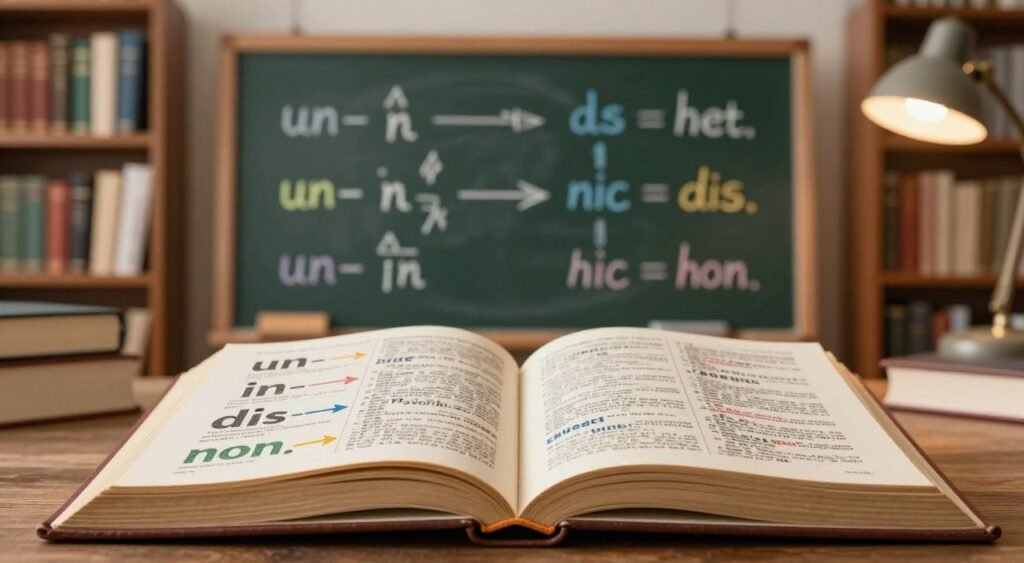
Common Negative Prefixes like Un- and In-
«Un-» and «in-» are great for making opposites. «Un-» works with many words, like «happy» becoming «unhappy».
«In-» goes before words starting with certain sounds. For example, «accurate» becomes «inaccurate». Knowing these patterns helps a lot.
Using Dis- and Non- to Reverse Meaning
«Dis-» and «non-» are good for reversing words. «Dis-» shows the opposite, like «agree» becoming «disagree».
«Non-» means without something, like «non-smoker». Using these antonym prefixes makes talking easier.
Exceptions and Irregular Forms to Watch For
But, some words don’t follow these rules. They might need a different word to show the opposite.
For example, saying «un-good» is wrong. Instead, use «evil» or «poor». Knowing these exceptions helps you talk better.
Contextual Learning Through Sentence Construction
Learning to build sentences helps you use what you know in real life. Just memorizing words doesn’t help when you need to talk fast. It’s better to understand how word pairs work together.
Drafting Sentences with Contrasting Pairs
Making your own sentences helps you really get opposites. Putting two opposite words together makes you see their differences clearly. This way, you learn the real meaning of each word, not just its definition.
«The limits of my language mean the limits of my world.»
Using Conjunctions to Highlight Opposites
Conjunctions connect your ideas of opposites. Words like «but,» «whereas,» and «howver» tell us when to expect a change. Using them well shows you can handle complex sentences.
Here’s a table to show how conjunctions link terms:
| Term A | Conjunction | Term B |
|---|---|---|
| Generous | but | Stingy |
| Optimistic | whereas | Pessimistic |
| Ancient | howver | Modern |
Practicing with Fill-in-the-Blank Exercises
When you can write your own sentences, try antonym exercises. These tests make you think about the context clues to pick the right word. It’s like finding the right word in a conversation.
Doing these word pairs exercises often makes you better at picking the right word. Soon, you’ll know the right word without thinking, and you’ll talk more clearly and confidently.
Advanced Techniques for Nuanced Vocabulary
To really get good at words, you need to go beyond just opposites. Basic opposites are a start, but to talk well, you must understand words in different situations.
Choosing the right word makes your message clear and strong. This skill is key for anyone wanting to speak English better.
Distinguishing Between Near-Antonyms
Near-antonyms are words that mean almost the opposite but in different ways. For example, «happy» can be opposite to «sad,» «miserable,» or «discontented.»
Choosing the right word depends on the emotional weight you want to share. You need to think about the situation to pick the best word. This is a big step in mastering vocabulary.

Understanding Connotation and Tone
Every word has its own feel that changes how people see your message. Some opposites are neutral, while others are very positive or negative.
When picking an opposite, think about the tone you want. The wrong word can change your whole message, even if it sounds right.
Using Antonyms in Formal Writing
Formal writing needs to be precise to be trusted and clear. Using different opposites helps you not repeat yourself and keeps your readers interested.
In professional reports or essays, pick opposites that sound formal. This shows you know how to use language well and makes your points clear and strong.
Integrating Antonyms into Daily Conversation
Learning to use antonyms in everyday talk is exciting. It helps you go from knowing to doing. Using antonyms makes your thoughts clear and ideas easy to share.
Role-Playing Scenarios for Practice
Practice talking in real-life situations to get better. Try ordering food, asking for directions, or haggling at a market. Use opposites to share what you like or need.
In a job interview, say a project is challenging instead of simple. This shows you can handle complex situations.
Engaging in Descriptive Storytelling
Telling stories is a great way to learn new words. When you share your day, use opposites to make your story interesting. Say a movie was thrilling and short, or complex but rewarding.
This helps your brain remember words fast. It also makes your stories more fun to listen to.
Self-Correction Techniques During Speaking
It’s important to listen to how you speak. If you use a simple word, think of a better one. You can even record yourself to find areas to improve.
Don’t worry about mistakes. Correcting yourself makes you better and builds your confidence.
| Context | Common Word | Antonym | Impact |
|---|---|---|---|
| Workplace | Busy | Idle | High |
| Social | Friendly | Hostile | High |
| Travel | Near | Distant | Medium |
| Opinion | Optimistic | Pessimistic | High |
Common Pitfalls and How to Avoid Them
Learning opposite words is more than just remembering them. You need to pay close attention to details. Even those who are good at it can make mistakes sometimes. Knowing these common mistakes helps you speak and write better.
Confusing Antonyms with Synonyms
It’s easy to mix up antonyms and synonyms. Synonyms are words with similar meanings. Antonyms are words that are opposite. Precision is key when picking words to be clear.
«The difference between the right word and the almost right word is the difference between lightning and a lightning bug.»
Overusing Simple Opposites
Using only simple opposites like «good» and «bad» can make your speech sound the same. To get better at English grammar, use more detailed words. This way, you can show different shades of meaning.
| Basic Pair | Advanced Alternative | Context |
|---|---|---|
| Good / Bad | Excellent / Dreadful | Quality |
| Big / Small | Enormous / Tiny | Size |
| Happy / Sad | Elated / Dejected | Emotion |
Misapplying Prefixes to Root Words
Many people have trouble with antonym prefixes. They think every word follows the same rule. But, you must check if a prefix like «un-,» «in-,» or «dis-» fits the root word. Using them wrong can make words that don’t exist.
If you’re not sure, always check a dictionary. Consistency and accuracy will make you more confident. Language is flexible, but sticking to rules helps you communicate better.
Recommended Resources for Continued Practice
To keep improving in English learning, you need the right tools. Good materials make it easy to add antonym exercises to your day. They help you go from knowing a little to really mastering it.
Digital Tools and Vocabulary Apps
Today’s tech has great tools for tracking your progress. Apps like Anki or Quizlet let you make flashcards for daily practice. They use spaced repetition to help you remember words for a long time.
Recommended Dictionaries and Thesauruses
A good dictionary is key for serious study. The Merriam-Webster online is great for clear definitions and examples. Also, use a thesaurus to see how words relate to their opposites in different situations.
Engaging with English Literature and Media
Reading books and listening to podcasts teach you how people speak naturally. When you see a new word in a book, try to find its opposite. This way, you learn how words are used in everyday life.
| Resource Type | Primary Benefit | Best For |
|---|---|---|
| Vocabulary Apps | Spaced Repetition | Daily Quick Drills |
| Online Dictionaries | Precise Definitions | Deep Word Analysis |
| English Literature | Contextual Usage | Advanced Fluency |
Conclusion
Learning antonyms is a big step. It makes you better at sharing ideas. You now have tools to talk and write more clearly.
Using English Antonyms With Practical Examples is key. Your words will get stronger as you use them every day.
Being consistent is crucial. Spend a little time each day on new words. It’s a journey, but it’s worth it for your speaking skills.
Use Merriam-Webster or Oxford Learner’s Dictionaries to check your words. Making English Antonyms a part of your daily life keeps your skills sharp.
Talk about your progress with friends or join online groups. Your hard work will help you make new connections. Keep at it and enjoy getting better at speaking.