
Going to a new country can be exciting and scary. You might worry about getting around airports or ordering food. Knowing Essential English Travel Vocabulary for Every Trip helps you handle these challenges easily.
Language is more than just talking. It’s a powerful tool for connection. With the right words, you feel less stressed and have real experiences. People like it when you try to speak their language, which makes them friendlier.
Learning to communicate well makes you brave to see new places. This guide will help you feel more confident. You’ll start to enjoy your travels more, one word at a time.
Mastering the Basics of Travel Communication
Good travel communication starts before you get to the airport. Learning some language before you go makes traveling easier. It turns what might feel scary into a fun way to meet new people.
Setting Your Intentions for Language Learning
First, think about what you’ll need to say on your trip. Don’t try to learn everything. Just focus on what you’ll really use, like saying «hello» or «where is the restroom?»
Make a list of things you might say, like «I’d like a room» or «Can I have the menu?» This helps you feel ready for anything. Your goal is to be understood, not to speak perfectly.
Understanding Contextual English
Language is more than words. It’s also about knowing when to be formal or friendly. For example, you might speak differently to a hotel staff than to a friend.
Learning to speak in different ways helps you avoid mistakes. Watch how locals use polite words like «please» or «thank you.» This makes your travel communication better and helps you make friends.
Navigating Airport Procedures and Security
Going through the airport needs special communication skills. This helps your trip start smoothly. Even big airports can be easy if you speak clearly to staff.
Knowing how to talk to people helps you get through faster. It also keeps you from getting stuck in travel problems.
Checking In and Baggage Claims
The first step is usually at self-service kiosks or counters. When you meet an agent, have your booking reference number and passport ready. If your flight is late, stay calm and ask clear questions.
Here are some phrases to help with your bags and check-in:
- «Could you please check if my flight is on time?»
- «I have one checked bag and one carry-on item.»
- «Is there an option to upgrade my seat for this flight?»
- «My flight has been delayed; what are my rebooking options?»
Communicating with Security Personnel
Going through security can be scary. But, knowing key airport security phrases makes it easier. Always listen and answer quickly to keep things moving.
If you’re not sure about a rule, it’s okay to ask. Using the right airport security phrases shows you’re ready and respect safety. Keep your boarding pass and ID out to avoid delays.
«Clear communication is the foundation of a stress-free travel experience, even at international security checkpoints.»
Mastering Transportation and Getting Around
Clear communication is your best travel companion. It makes city travel easier. Learning public transportation English lets you explore freely.
Asking for Directions in Urban Environments
Lost? Just ask a local for help. Say, «Excuse me, could you tell me how to get to the nearest subway station?»
Listen for landmarks like prominent buildings or parks. If unsure, ask, «Could you please repeat that more slowly?»
Using Public Transit Systems
Public transit varies, but key words stay the same. Know terms like transfer, platform, and terminal. This makes navigating easier.
Always listen for announcements. If lost, ask a station attendant, «Does this train stop at the city center?»
Buying Tickets and Understanding Schedules
Buying a ticket starts your journey. Ask, «How much is a one-way ticket to the airport?» or «Do you offer a day pass for tourists?»
Knowing the schedule is key. Ask, «When is the next bus scheduled to arrive?» or «How often do these trains run during the weekend?»
Checking Into Accommodations with Confidence
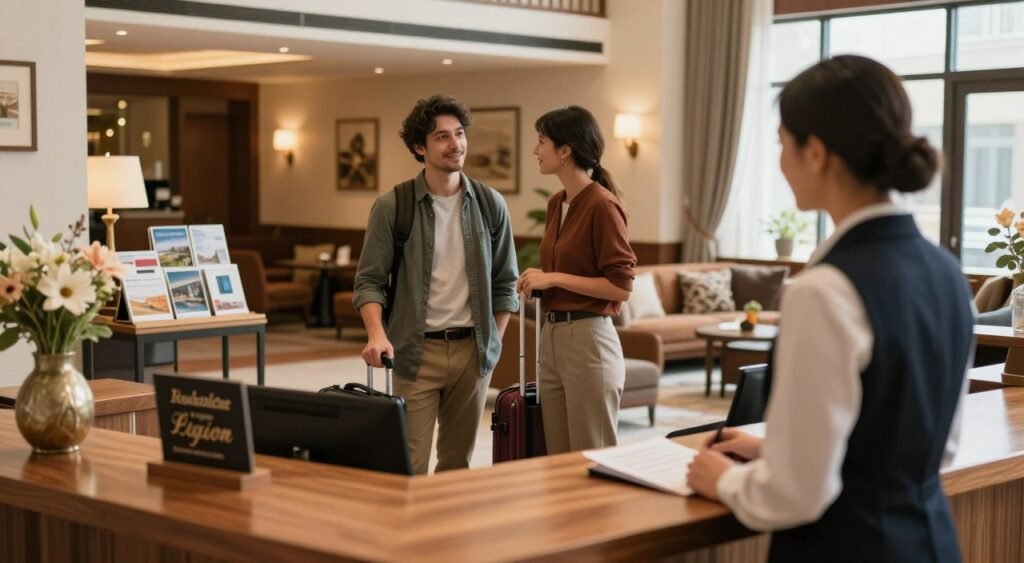
When you arrive at your accommodation, it’s your first real interaction. Knowing hotel check-in vocabulary makes it easy. A few key phrases can make your arrival smooth and your needs clear.
The Hotel Check-in Process
At the front desk, say hello and show your ID and booking. You might say, «I’m Smith» or «I’m here for three nights.» Clear communication helps the staff find your info fast.
If you need something special, like a quiet room, ask right away. Using the right hotel check-in vocabulary helps get the room you want.
Requesting Amenities and Reporting Issues
For extra comfort, ask for towels, pillows, or the Wi-Fi password. Just ask nicely, like «Can I have two extra towels?» or «How do I get Wi-Fi?»
If there’s a problem, like a leaky faucet, tell the staff professionally and promptly. Say, «The AC isn’t working; can someone fix it?»
Staying calm and polite helps fix problems faster. Knowing hotel check-in vocabulary is key for a great trip. It helps you get what you need and keeps your stay positive.
Dining Out and Ordering Food
Traveling lets you enjoy dining out in English and dive into local culture. Whether it’s a busy bistro or a cozy cafe, knowing how to talk helps. It makes you feel sure while trying new foods.
Navigating Menus and Dietary Restrictions
Menus can be tricky, with local foods and unknown ingredients. If you have dietary restrictions, tell the server before ordering. Say, «Does this dish have nuts?» or «Is it gluten-free?»
Staff usually want to help. If something sounds odd, ask for more info. You might say, «What’s this ingredient?» or «Is it spicy?»
Interacting with Waitstaff
Talking well with your server makes dining better. When ready to order, speak clearly and nicely. Start with, «I’ll have the grilled salmon, please.»
Want a suggestion? Ask, «What’s your favorite dish?» When done, ask for the bill with, «Could I have the check, please?» Sharing your thanks is nice.
| Situation | Recommended Phrase | Purpose |
|---|---|---|
| Asking for a table | «A table for two, please.» | Securing seating |
| Dietary needs | «I am allergic to shellfish.» | Ensuring safety |
| Ordering | «I will have the chicken salad.» | Placing an order |
| Payment | «Could I have the check?» | Requesting the bill |
Essential English Travel Vocabulary for Every Trip: Emergency Situations
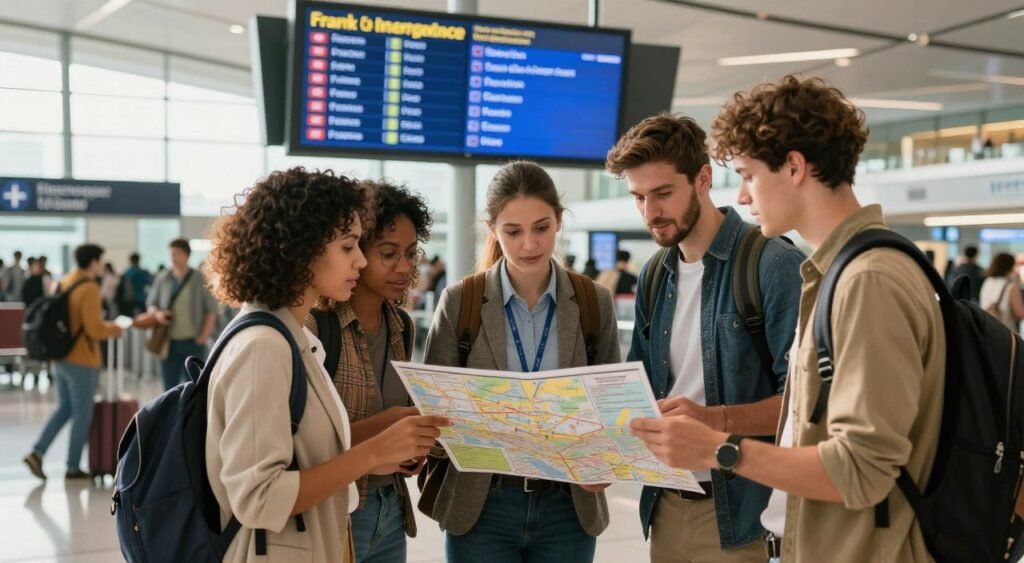
We hope for smooth travels, but knowing how to handle emergencies is key. Learning emergency travel English helps you talk clearly when it matters most. Being ready gives you the confidence to deal with tough moments calmly and focused.
Seeking Medical Assistance
If you get sick, you need to tell a doctor what’s wrong. Use simple words so they get it right away. You might say, «I need to see a doctor,» or «I am having an allergic reaction.»
If you’re in pain, tell them where it hurts. For example, «My chest hurts,» or «I have a sharp pain in my stomach.» Always carry your insurance information and a list of your current medications in your wallet.
Reporting Lost or Stolen Items
It’s stressful to lose your passport or wallet, but telling someone fast is important. When talking to hotel staff or police, be clear and give all the details. Say, «I need to report a stolen item,» or «I have lost my passport.»
Describe the item and where you last saw it. Staying composed helps the authorities help you better. Keep digital copies of your important documents in a safe place to make reporting easier.
| Situation | Key Phrase | Action Required |
|---|---|---|
| Medical Emergency | «Please call an ambulance.» | Provide your exact location. |
| Lost Passport | «I need to contact my embassy.» | Visit the nearest consulate. |
| Stolen Wallet | «I need to file a police report.» | Request a copy for insurance. |
| Allergy Alert | «I am allergic to this.» | Show your medical card. |
Practicing these phrases makes you better at emergency travel English before you even leave. Having a plan means you can face surprises with ease. Your safety is the most important thing on your trip.
Shopping and Handling Financial Transactions
Knowing how to talk clearly is key when shopping in English abroad. Whether it’s a fancy store or a street market, knowing about money helps a lot. A few simple phrases can make shopping easy and fun.
Asking About Prices and Discounts
When you see something you like, you might want to know the price or if it’s on sale. Start by saying, «Excuse me, how much is this?» or «Is it on sale?»
In markets where you can haggle, ask, «Can we talk about the price?» or «Do you have a discount for buying more?» Always ask about returns too. A simple question like, «What if it doesn’t fit?» can help avoid problems later.
Managing Currency and Payment Methods
Knowing how to handle money is important when shopping in English. Before you pay, find out what payment methods are okay. You can say, «Do you take credit cards, or is it cash only?»
When exchanging money, be clear about what you want. Say, «I’d like to pay in local currency.» If you’re not sure about the total, ask, «Can you show me the total on the screen?»
Here are some tips for smooth transactions:
- Confirm the total: Always check the final amount before paying.
- Ask for a receipt: Getting a receipt helps track your spending.
- Digital payments: If you use mobile wallets, ask, «Do you accept contactless payments?»
Learning these simple things makes shopping in English easier anywhere. Clear talk helps avoid mistakes and lets you enjoy shopping more.
Socializing and Making New Connections
Talking to people can make your trip unforgettable. It’s more than just finding places to stay. Using travel conversation tips makes you feel at ease.

Starting Conversations with Locals
Talking to strangers might seem scary, but most are eager to share. Ask about a nearby spot or a good café. A warm smile and relaxed body language show you’re friendly.
Ask about what’s around you to keep the chat natural. Commenting on someone’s book or meal is a great way to start. These small steps help you connect without interrupting.
Understanding Cultural Nuances in English
Every place has its own way of talking. In many places, talking about the weather or news is common. Knowing these helps you avoid awkward moments.
Humor is important, but it can be tricky in a new language. Stick to simple jokes until you’re more comfortable. Active listening shows you care about what they say.
Respecting people’s space and watching how locals act is key. Being patient and observant makes connecting with others rewarding.
Utilizing Technology to Bridge Language Gaps
Your phone is a key to understanding new places. Translation apps for travel help you read signs and talk to locals. They make you feel safer and more confident when you don’t speak the language.
Best Translation Apps for Travelers
Many apps are great for travel. Google Translate is top for quick translations with its camera feature. DeepL is best for detailed texts. Microsoft Translator works well for talking with groups.
Download languages before you go to use them offline. Practice using these translation apps for travel before your trip. This helps you get used to how they work.
| App Name | Best Feature | Offline Mode |
|---|---|---|
| Google Translate | Camera Translation | Yes |
| DeepL | Natural Phrasing | Limited |
| Microsoft Translator | Group Chat | Yes |
When to Rely on Digital Tools vs. Human Interaction
Technology is very helpful, but don’t forget to talk to people. Using only your phone can make it hard to connect. Use it to help understand things, but talk to people to make real friends.
Think of your phone as a tool to learn, not a way to avoid trying. When you try to speak, even if you make mistakes, people will appreciate it. Mix using translation apps for travel with smiling and waving to have a real experience.
Practicing Active Listening and Clarification
Active listening is key for travelers in busy places. It helps you understand even when you miss words. This skill boosts your confidence when exploring new places.

Asking People to Repeat or Slow Down
Feeling overwhelmed in loud places is normal. It’s okay to ask for slower speech. Being polite helps the other person want to help you.
Use simple phrases to ask for slower speech. Say, «Could you please speak a little slower?» or «I am sorry, could you repeat that one more time?» These show you’re really interested.
Confirming Understanding Through Paraphrasing
After getting the info, check if you got it right. Paraphrasing means repeating what you heard in your own words. This stops mistakes and shows you’re fully there.
For example, if someone gives you directions, say, «So, I should turn left at the next corner and walk two blocks?» This checks the directions and lets the speaker fix any mistakes. Using these active listening techniques makes your travel talks better.
| Strategy | Purpose | Example Phrase |
|---|---|---|
| Requesting Pace | Slow down speech | «Could you speak slower?» |
| Requesting Repetition | Clarify missed words | «Could you say that again?» |
| Paraphrasing | Confirm understanding | «So, you mean that…?» |
| Seeking Confirmation | Verify final details | «Is that correct?» |
Building Your Personalized Travel Phrasebook
Creating a travel phrasebook just for you can make your trips better. It’s not just about any guide. It’s about having the right words for your trip. Preparation is the key to confidence when you’re in a new place.
Organizing Vocabulary by Trip Type
Sorting your notes by trip type is smart. Whether it’s a big meeting or a mountain trip, you’ll need different words. Grouping your phrases makes it easy to find what you need fast.
- Business Travel: Learn formal greetings, meeting terms, and how to act professionally.
- Adventure Trekking: Know safety words, directions, and questions about your gear.
- Family Vacations: Find phrases for fun with kids, health needs, and food requests.
Reviewing and Refining Your Phrases
Your travel phrasebook should grow with you. After each trip, check what worked and what didn’t. Remove old phrases and add new ones you learned.
Keeping your guide up-to-date makes it a reliable reference tool for your next trip. Fresh content means you’re ready for any communication challenge.
| Trip Category | Primary Focus | Key Vocabulary Type |
|---|---|---|
| Business | Professionalism | Formal greetings, scheduling |
| Adventure | Safety | Emergency, terrain, gear |
| Family | Convenience | Services, food, logistics |
Conclusion
How well you talk shapes your travel experiences. Learning English for tourists helps you make friends and move easily in new places.
Being ready is key. Organize your words and listen well to get better at traveling. Every talk makes you more confident.
You can now deal with tough situations like getting lost or needing help. Use these tips to grow from every problem. Your hard work makes each trip better and more fun.
Get ready for your next trip, knowing you can handle any English-speaking place. Share your stories with others to keep improving. Your travel skills will grow with each new place you visit.